

 Login / Register
  CATEGORIES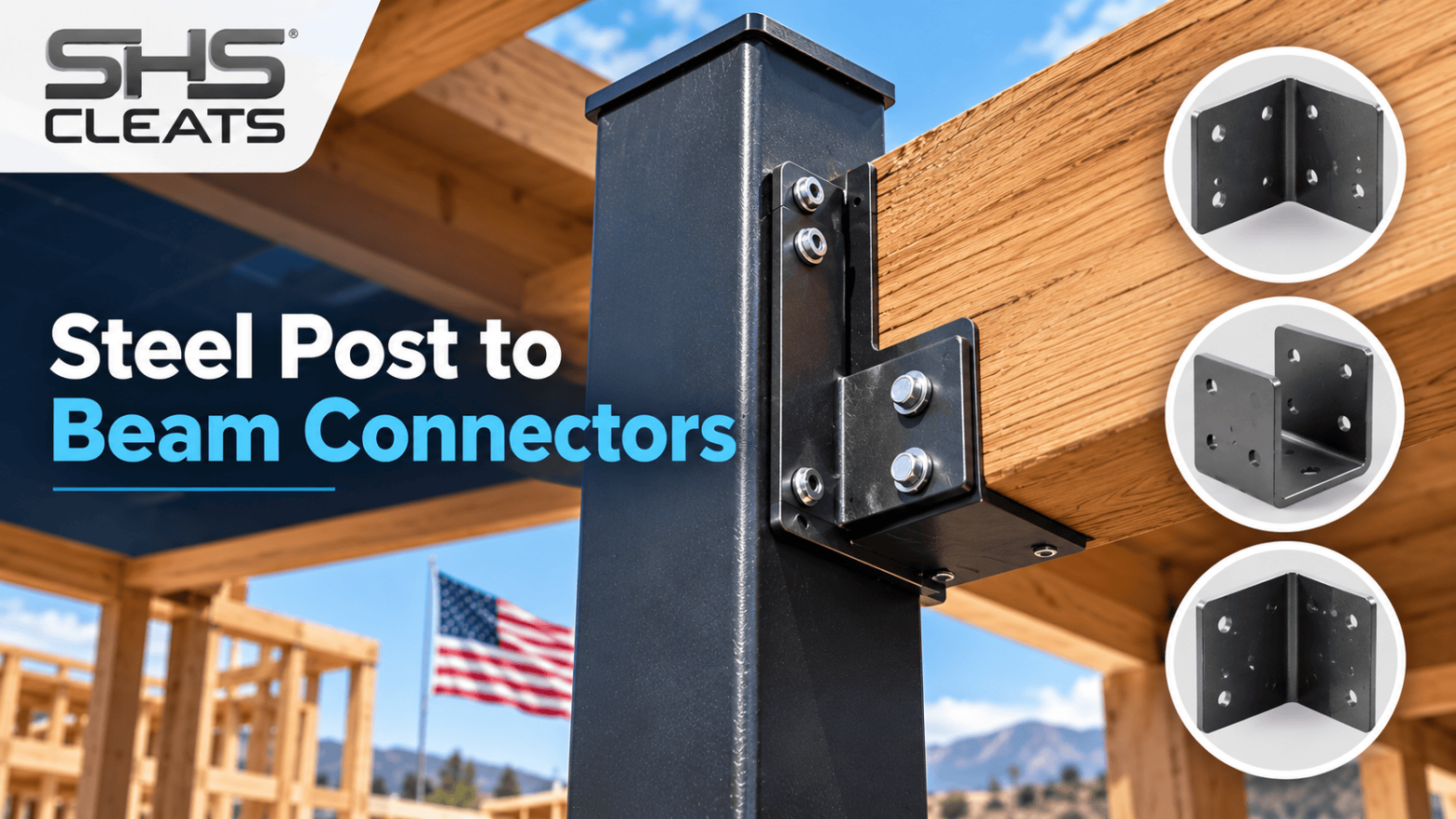
Walk through any building supply store in the US and you’ll find an entire aisle of post-to-beam hardware — brackets, caps, hangers, and connectors in dozens of shapes and sizes. For a basic wood-to-wood deck connection, a standard post cap gets the job done. But the moment you’re working with HSS (Hollow Structural Section) square steel posts, the options get more specific — and picking the wrong connector can mean a failed inspection, an under-strength connection, or a rework bill you didn’t budget for.
This guide is written for US contractors, builders, and structural engineers working with square hollow steel posts. We’ll cover the main connector types available, what separates good hardware from bad, galvanizing requirements by US climate zone, and a clear breakdown of which connector works for which application.
The Main Types of Steel Post to Beam Connectors
Not every connector on the market is designed for steel posts. Before you spec anything, it helps to understand what you’re actually choosing between.
1. Standard Post Cap Brackets
The most familiar type — a U-shaped or saddle-style bracket that sits on top of a post and cradles the beam from below. These are designed around wood post dimensions and work well for lumber-to-lumber connections on standard decks and pergolas.
Where they fall short on steel posts: Most post cap brackets aren’t engineered to grip the outside face of a hollow steel section. They sit on top and rely on the flat bearing surface — which means beam height is fixed at the top of the post, there’s no side-face connection, and there’s limited lateral restraint. For HSS column connections, this usually isn’t the right tool.
2. Factory-Welded Cleats
The traditional approach to HSS post connections. The posts go to a fabrication shop, a welder fixes the cleats at the specified heights, and the finished assemblies come back to the job site ready to install.
The problem: Once those cleats are welded, the beam height is locked in. If the footing heights or slab elevation on site differs even slightly from the drawings — and it often does — you’re grinding off welds and starting over. Pre-welded assemblies also run 10 to 14 feet long, making them awkward to transport and handle on tight job sites.
Factory welding still makes sense for some commercial applications with certified welders on site and zero tolerance for field adjustments. For residential work, there’s a better option.
3. Slide-On Adjustable Cleats
Slide-on cleats are precision-engineered to fit the outside dimension of a specific HSS post size. They slide directly onto the post, move up or down to the exact beam height you need on site, and then get locked in place with tek screws, structural bolts, or a combination of both.
No factory welding. No rigid pre-assembled units to truck around. No rework when the site doesn’t match the drawings exactly.
This is what SHS Cleats manufactures — a full range of patented, hot-dip galvanized slide-on connectors for HSS post sizes from 2½×2½” through 8×8″. The system is PCT patented and engineering-certified, with published load tables for permit submissions.
For most residential and light commercial applications, this is the connector type worth specifying.
4. Ornamental / Decorative Post Connectors
Heavy-gauge steel connectors with a powder-coated black finish, designed for exposed pergola and outdoor structure applications where the hardware is visible. Popular for backyard builds where the connection is part of the aesthetic.
Limitation: These aren’t typically engineered for heavy structural loads. They work well for light timber pergola beams but aren’t suited to PFC steel beams or high-wind load connections.
What to Look For When Buying a Steel Post to Beam Connector
Published Load Ratings
This is non-negotiable on any permitted project. The connector needs to have published load tables showing allowable vertical (shear) load, lateral load, and uplift resistance. If the manufacturer can’t provide this data, don’t use the product on a structural connection.
Building inspectors in most US jurisdictions will ask for connector documentation during structural inspections. Connectors with ICC-ES evaluation reports or equivalent engineering certification make that conversation straightforward.
Steel Thickness
Heavier gauge means a stiffer, stronger connection. Here’s a quick reference for residential steel connections:
| Gauge / Thickness | Suitable For |
|---|---|
| 18 gauge (0.05″) | Light-duty only — not recommended for structural HSS connections |
| 14–16 gauge (0.06″–0.08″) | Standard residential connections, light loads |
| 12–11 gauge (0.10″–0.12″) | Heavier residential and light commercial connections |
| 3/16″ (0.188″) | Heavy structural or high-load applications |
For HSS post connections carrying roof loads, floor loads, or any application where the connection is structural — specify 12 gauge minimum. Lighter gauge hardware may pass a visual inspection but won’t perform under real load conditions.
Galvanizing Type
Exterior steel connections corrode. The question isn’t whether — it’s how fast. Galvanizing slows that process down, but the type of galvanizing matters a lot depending on your climate.
| Galvanizing Type | Protection Level | Best Used For |
|---|---|---|
| Electroplating (thin zinc layer) | Low | Interior applications only |
| Powder coat over bare steel | Low to medium | Decorative outdoor use — limited structural life |
| Hot-dip galvanized (HDG) | High | All exterior structural connections |
| Hot-dip + powder coat | Highest | Coastal, marine, and high-humidity environments |
Hot-dip galvanizing is the standard for exterior structural steel connections across the US. The zinc coating bonds directly to the steel surface and self-sacrifices — it corrodes slowly in place of the underlying metal. For jobs along the Florida coast, Gulf Coast, the Carolinas, or the Pacific Northwest, specify hot-dip as an absolute minimum. In salt-air environments closer to the water, hot-dip plus powder coat is the better call.
All SHS Cleats products are hot-dip galvanized as standard.
Positive Connection
Under the International Building Code (IBC) and International Residential Code (IRC), structural beam-to-post connections must resist lateral forces and uplift — not just vertical load. A connector that relies on gravity or friction alone doesn’t meet this requirement and will fail inspection in most US jurisdictions.
What a positive connection looks like in practice: the cleat is fastened mechanically to both the post and the beam through at least two fastening points each. The connection resists load in all directions — shear, lateral, and uplift.
Fastening Methods: Tek Screws, Bolts, or Welding?
Once you’ve chosen your connector, you have three main options for how to fasten it. Each has its place.
| Method | Speed | Strength | Equipment Required | Field-Adjustable? |
|---|---|---|---|---|
| Tek screws only | Fast | Medium | Drill/driver | Yes |
| Structural bolts | Medium | High | Drill + wrench | Yes |
| Tek + stitch weld | Medium | Very high | Drill + welder | No |
| Full weld | Slow | Highest | Welder on site | No |
For standard residential decks, porches, and pergolas, tek screws or structural bolts are sufficient and keep the connection reversible if adjustments are needed. For higher load applications — roof connections, long-span beams, or anything your structural engineer flags for a specific connection capacity — step up to tek-and-weld or full weld.
Refer to the SHS Cleats installation guide for fastening specifications by post size and load condition.
Which Connector for Which Application
| Your Project | Right Connector |
|---|---|
| Lumber beam to side face of HSS post (deck, porch, verandah) | SHS Timber Beam Cleat |
| Lumber floor bearer sitting on top of HSS post | SHS Top Plate Cleat |
| Steel PFC channel beam to HSS post (heavier loads) | SHS PFC Beam Cleat |
| Diagonal bracing rod to HSS post (sub-floor, lateral bracing) | SHS Bracing Rod Cleat |
| Steel angle bracing to HSS post (high-wind, sub-floor bays) | SHS Steel Angle Bracing Cleat |
| HSS post base to concrete footing or slab | SHS Baseplate |
Frequently Asked Questions
What is the strongest type of steel post to beam connector?
Full weld gives the highest strength, but it’s not necessary for most residential jobs. A tek-and-stitch-weld combination hits very high connection capacity while still allowing on-site positioning before the weld goes on. Where no welder is available, structural bolts through a properly engineered slide-on cleat fully satisfy IBC/IRC positive connection requirements for standard residential loads.
Do I need an engineer to approve my post-to-beam connection?
Depends on your jurisdiction and project scope. Smaller residential decks can often use prescriptive IRC details without a stamped drawing. Larger decks, elevated structures, high-wind or seismic zone projects, and commercial applications generally need a licensed structural engineer to review the connection design. SHS Cleats provides published load table documentation that engineers can use directly in their calculations.
What’s the difference between a post cap and a beam cleat?
A post cap sits on top of the post and cradles the beam from below — designed for wood-to-wood connections. A beam cleat attaches to the side face of a steel post and supports the beam laterally — designed specifically for HSS column connections. The two aren’t interchangeable when you’re working with steel posts.
How many fasteners does a steel post to beam connection need?
At minimum, two fastener points on the cleat-to-post face and two on the cleat-to-beam face. SHS Cleats provide four fastening points per face, which covers standard residential load requirements. For engineer-specified connections or heavier loads, refer to the published load tables for the required fastener count and size by post size.
Can the same cleat work for both lumber and steel beams?
No. Lumber beams use the SHS Timber Beam Cleat or Top Plate Cleat depending on the connection orientation. Steel PFC channel beams need the SHS PFC Beam Cleat, which is shaped to match the web profile of a PFC section. Using the wrong cleat for the beam type means a poor fit and an under-strength connection.
The Bottom Line
For wood-to-wood connections, a standard post cap bracket works fine. The moment you’re connecting to an HSS steel post, you need a connector engineered for hollow section steel — correctly sized to the post, hot-dip galvanized, with published load ratings and a positive connection method your inspector can verify on site.
Slide-on adjustable cleats give you the best combination of on-site flexibility, structural performance, and ease of installation for the majority of US residential and light commercial applications.
Browse the full SHS Cleats range — available for all standard US HSS post sizes from 2½×2½” to 8×8″. Engineering-certified, PCT patented, and available to order online with worldwide shipping.